
“Cs·DISC” with Madagascar plate


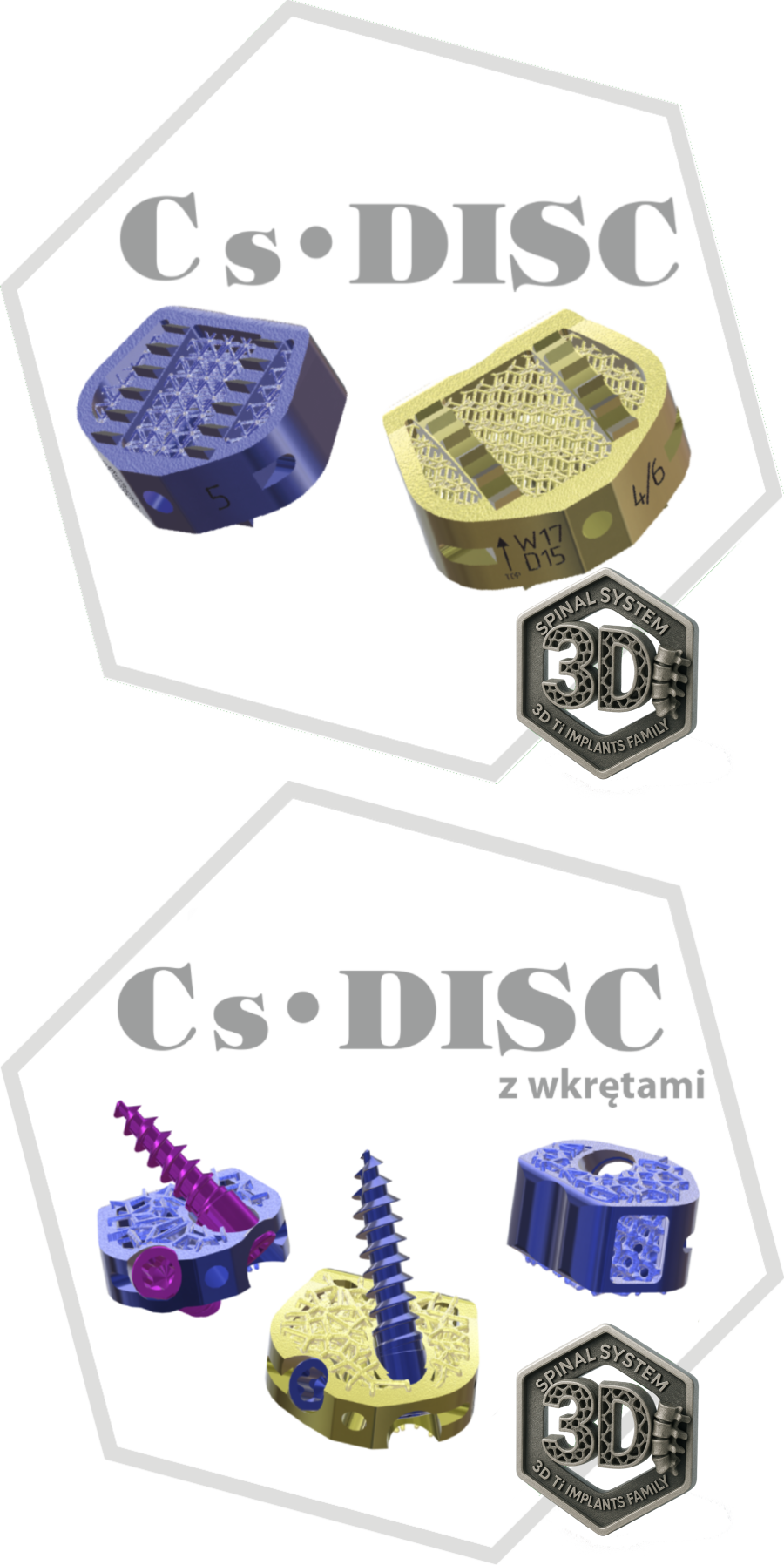
A unique cervical cage with “3D-Truss-Ti” structure
The Cs·DISC cervical disc prosthesis is intended for interbody stabilization of the cervical spine. Its purpose is to restore the natural height of the intervertebral space and to reconstruct and/or maintain physiological cervical lordosis.
The Cs·DISC implant is manufactured using EBT (Electron Beam Technology) from titanium alloy powder. The porous implant with a dedicated lattice structure creates excellent conditions for bone ingrowth, allowing bone to fill up to 65–70% of the implant volume. Directional, serrated upper contact surfaces interfacing with the vertebral bodies prevent implant shifting and displacement after insertion into the intervertebral space. The implant does not require filling with bone graft or bone substitute.
Cs·DISC – Stand-alone cervical interbody cage, 3D Ti
Cs·DISC with screws is a modern titanium interbody cage manufactured using 3D printing technology, intended for stabilization of the cervical spine at levels C3–C7 in ACIF/ACDF procedures. The implant is designed as a stand-alone solution, enabling interbody fusion without the need for an additional cervical plate, in line with current trends toward minimally invasive surgery.
The anatomical, rectangular shape of the implant combined with the 3D Ti structure supports rapid bony fusion and high primary stability. Cs·DISC is available in multiple geometric variants—flat, lordotic, unilateral convex, and unilateral convex lordotic—allowing precise restoration of intervertebral height and physiological cervical lordosis. The screw-fixation version features two locking screw holes that anchor the implant in the adjacent vertebral bodies and reduce the risk of migration.
Cs·DISC with screws may also be used in a hybrid configuration together with the “Madagascar” cervical plate in cases requiring enhanced stabilization. The implant is part of the DERO Spinal System.
“Cs·DISC” with Madagascar plate
At the end of the 20th century, technologies stemming from aero-space engineering opened a world of new possibilities in 3D spatial architecture. LfC managed to transmit this space technology to the field of spinal implants. Electron beam melting (EBT-Electron Beam Technology) of Ti-alloy powder with temperatures over 2000 deg. C in a vacuum chamber -that is the essence of technology used to create a new generation of 3D-implants. Apart from the structure itself, which favors bone ingrowth within the spatial cells, the implant’s design enables an accelerated osteointegration mechanism reducing fusion time by 40-50 percent and more. This new phenomenon was studied and called „Ivy-like mechanism, L.C.” as a metaphor for the natural growth process of ivy, which climbs along the specially made rough surface of truss design.
Publications:
Ciupik L.F., Kierzkowska A., Cęcek J., Pieniążek J. Sterna J., Cieślik-Górna M. The use of incremental technology to produce 3D-Truss Ti6Al4V implants which improves the spinal treatment effectiveness. Key Engineering Materials; 2016; 687: 179-184.
Ciupik L.F., Kierzkowska A. Technology-biomechanical evaluation of metal biomaterials derived by layer technology. Engineering of Biomaterials; 2010; 93: 14-18.
Bulletins:
BULLETIN No. 03/2020
BULLETIN No. 02/2020
Bulletins:
BULLETIN No. 03/2020
BULLETIN No. 02/2020
Poster: Innovative 3D-Ti-Printing in a Worldwide spinal surgery